
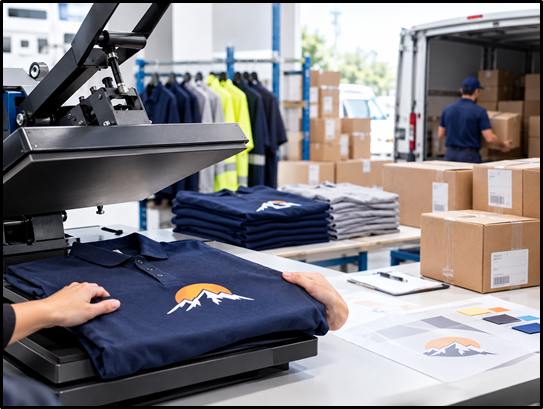
For clothing brands, uniform suppliers, wholesalers, and trade buyers, delivering high-quality apparel requires more than selecting the right garments. Businesses also need dependable branding, consistent production, and efficient delivery to meet customer expectations. From custom logos on workwear to shipping finished uniforms across multiple locations, every stage of the supply chain contributes to the final customer experience.
Two services that can make a difference are heat transfer printing and garment shipping services. When these processes are managed effectively, businesses can maintain consistent branding, simplify order handling, and build a more reliable apparel supply chain.
What Is Heat Transfer Printing?
Heat transfer printing is a garment decoration method that uses heat and pressure to apply a printed design to fabric. The artwork is prepared on a suitable transfer material before being applied to the garment using a heat press.
This technique is widely used for uniforms, workwear, promotional clothing, and branded apparel. It can support detailed designs, logos, names, and other branding requirements, depending on the transfer technology and fabric.
For trade buyers, the main benefit is the ability to reproduce approved designs across multiple garments while maintaining a consistent appearance.
Why Heat Transfer Printing Matters for Trade Buyers
Branding is an important part of corporate uniforms and workwear. Businesses often need their garments to display company logos, employee names, department details, or other identification.
Professional heat transfer printing can help manufacturers and uniform suppliers apply these designs efficiently. When artwork, colour specifications, and placement requirements are agreed in advance, production teams can follow a consistent process across an entire order.
This is especially useful for businesses managing bulk uniform production. Instead of treating every garment as a separate branding project, approved artwork can be reproduced across a wider production run.
Benefits of Custom Garment Printing
Different businesses have different branding requirements. A construction company may need high-visibility workwear with a company logo, while a corporate supplier may require branded polo shirts, jackets, and trousers.
Heat transfer printing can be suitable for a range of garment applications, including:
- Corporate uniforms and branded workwear
- Promotional apparel
- Sports and team clothing
- Custom employee garments
- Industrial clothing identification
- Multi-colour logos and detailed artwork
The final result depends on the transfer material, fabric, application settings, and quality-control process. For trade orders, choosing a suitable decoration method for the garment is an important part of production planning.
What Makes a Quality Heat Transfer?
A successful transfer requires more than applying a design to fabric. The artwork, transfer type, garment material, and application settings all need to work together.
Before bulk production, businesses should consider:
Artwork and placement
The logo or design should be prepared according to the required size, colours, and position. Consistent placement helps ensure that branded garments look professional across a production run.
Fabric compatibility
Cotton, polyester, blended fabrics, and performance materials can respond differently to heat and pressure. The transfer method should be suitable for the garment being decorated.
Application and testing
Correct heat, pressure, and application time can affect the quality of the finish. Sampling and testing help manufacturers identify potential issues before larger quantities are produced.
Durability
For workwear and uniforms, the printed design should be suitable for the garment’s intended use and care requirements. Buyers should consider washing conditions and performance expectations when selecting a decoration method.
Understanding Garment Shipping Services
Manufacturing is only one part of supplying apparel. Once garments have been produced, decorated, checked, and packed, they need to reach the right destination.
Garment shipping services help businesses manage the movement of finished clothing from production or fulfilment facilities to trade buyers, customers, or other specified locations.
These services may include order preparation, packing, labelling, dispatch coordination, and delivery support. For businesses handling bulk orders, organised shipping can make the final stage of the supply chain easier to manage.
Why Efficient Shipping Matters for Apparel Businesses
Apparel orders can involve different sizes, colours, garment styles, and customer requirements. A single trade order may need to be distributed across several business locations.
Without an organised process, businesses may face unnecessary sorting, repeated handling, and additional warehouse work.
Professional garment shipping services can support a more structured approach to distribution by helping ensure that garments are packed and dispatched according to agreed instructions.
This is particularly useful for uniform suppliers, wholesalers, and clothing brands that manage regular customer orders.
Direct Shipping for Trade Buyers
Direct-to-customer shipping is one way businesses can simplify their distribution process. Instead of receiving every finished garment at their own warehouse, trade buyers may arrange for completed orders to be dispatched directly to their customers or specified sites.
This approach can help reduce unnecessary handling and support multi-location deliveries.
For example, a uniform supplier managing clothing for several companies may need garments delivered to different offices, warehouses, or work sites. A coordinated shipping process can help organise these deliveries according to customer requirements.
The suitability of direct dispatch depends on the order structure, delivery locations, and fulfilment arrangements agreed with the manufacturing partner.
Combining Printing, Finishing, and Shipping
A connected production process can make apparel supply more efficient. When garment decoration, finishing, and dispatch are managed through a coordinated workflow, businesses can reduce unnecessary handoffs between suppliers.
A typical process may include:
- Confirm garment specifications and artwork.
- Review the required transfer method and fabric compatibility.
- Produce and approve samples.
- Complete bulk garment manufacturing.
- Apply heat transfer printing and inspect the finish.
- Check garment quality, sizing, and order quantities.
- Pack garments according to customer requirements.
- Dispatch orders to the buyer or specified delivery locations.
This approach allows trade buyers to manage branding and distribution as part of one organised supply chain.
Choosing the Right Apparel Manufacturing Partner
When selecting a garment production partner, businesses should consider the full range of services available. Manufacturing capability is important, but so are decoration, quality control, finishing, and delivery support.
Uniform World provides trade-focused heat transfer solutions for garment manufacturers, uniform suppliers, and distributors. Its trade heat transfer service supports bulk branding, custom artwork, and repeat production requirements. The company also offers garment finishing and direct customer shipping services for trade buyers.
Businesses can explore the heat transfer printing available through Uniform World to learn more about its production and decoration capabilities.
Conclusion
Successful apparel supply depends on more than producing garments. Businesses also need consistent branding, suitable decoration methods, organised finishing, and dependable delivery.
Heat transfer printing can help trade buyers create professional branded clothing across bulk orders, while garment shipping services can simplify the movement of finished apparel to customers and business locations.
By choosing a manufacturing partner that understands both garment decoration and distribution, clothing brands, uniform suppliers, and wholesalers can build a more coordinated approach to production and long-term supply.
Frequently Asked Questions
1. What is heat transfer printing used for?
Heat transfer printing is used to apply logos, artwork, names, and other designs to garments. It is commonly used for uniforms, workwear, promotional clothing, and branded apparel.
2. Is heat transfer printing suitable for bulk uniform orders?
Yes. Heat transfer printing can be used for bulk uniform orders when the transfer method, artwork, fabric, and application settings are suitable. Sampling and quality checks help support consistent results.
3. What are garment shipping services?
Garment shipping services help businesses prepare and dispatch finished clothing to trade buyers, customers, warehouses, or specified delivery locations. They may include packing, labelling, and shipping coordination.
4. Can branded garments be shipped directly to customers?
Yes. Depending on the fulfilment arrangement, branded garments can be dispatched directly to customers or business locations. This can help reduce unnecessary handling for trade buyers.
5. How do heat transfer printing and shipping work together?
Heat transfer printing adds branding to garments, while shipping services help deliver the completed orders. Coordinating both processes can simplify production, finishing, packing, and distribution for apparel businesses.
