
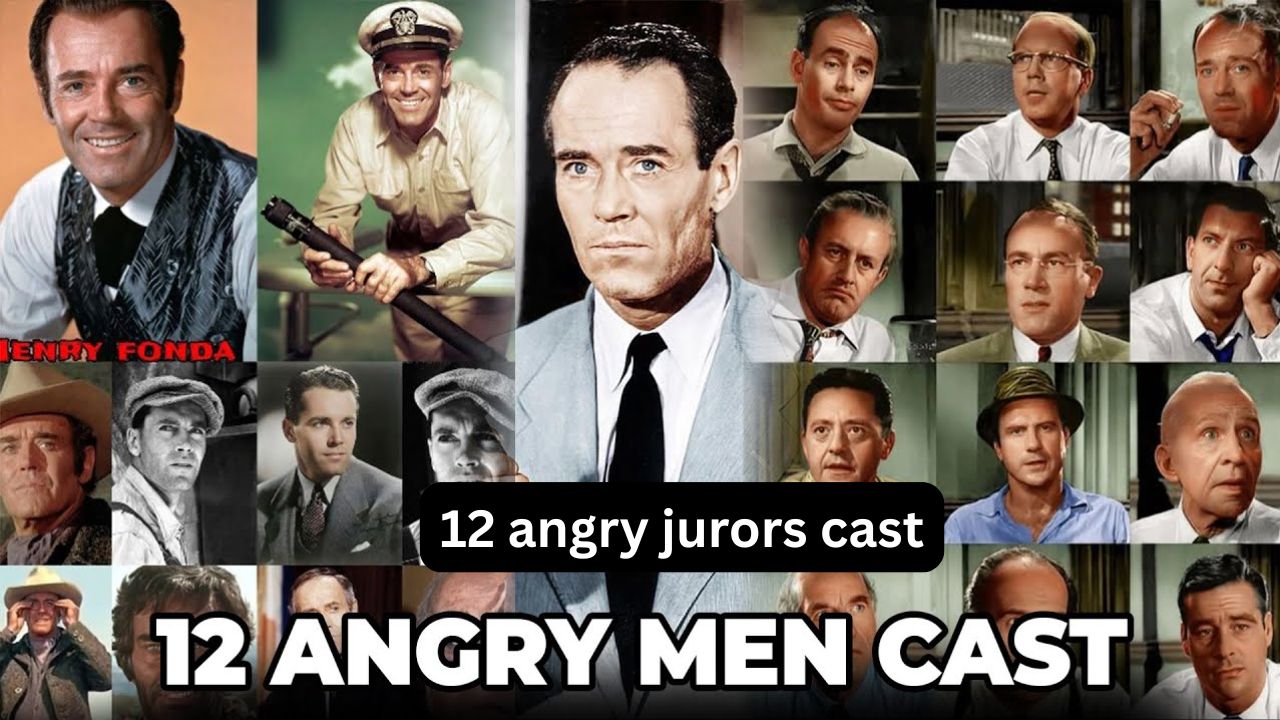
If you are searching for the 12 Angry Jurors cast, you may notice something confusing: there is no single cast list that applies to every production. Unlike a movie, this is a stage play, and different schools, community theaters, colleges, and professional groups cast different actors in the twelve numbered juror roles. The version commonly called Twelve Angry Jurors is the gender-flexible stage adaptation by Sherman L. Sergel, based on Reginald Rose’s Twelve Angry Men. The publisher describes it as a full-length drama that can be performed with a mixed cast.
That distinction matters if you are looking for the cast, characters, script, running time, or set. The character numbers remain broadly consistent, but the actors change from production to production. Some productions also use different staging choices, intermissions, and supporting roles.
This guide explains the 12 Angry Jurors characters, what each juror represents in the story, how long the play usually lasts, what the set looks like, and how the stage version relates to the famous 12 Angry Men movie.
Is 12 Angry Jurors a Movie or a Play?
12 Angry Jurors is primarily a stage play, not a separate movie with one definitive cast.
It comes from Reginald Rose’s Twelve Angry Men, which began as a television drama and was later adapted for the stage by Sherman L. Sergel. The Sergel stage adaptation is commonly performed under titles such as Twelve Angry Men, Twelve Angry Women, and Twelve Angry Jurors, depending on the casting format. Dramatic Publishing specifically notes that the Sergel version may be performed with a mixed cast as Twelve Angry Jurors.
The basic situation remains the same:
- Twelve jurors enter a jury room.
- A 19-year-old defendant has been accused of killing his father.
- The initial vote strongly favors a guilty verdict.
- One juror asks the others to examine the evidence more carefully.
- As the discussion continues, assumptions and contradictions come under pressure.
- The jurors must ultimately reach a unanimous decision.
The story therefore depends less on action and more on dialogue, evidence, personality, and changing opinions.
12 Angry Jurors Cast: Who Are the Main Characters?
The most important thing to know is that the characters are identified mainly by numbers rather than personal names. This makes the jury function almost like a miniature cross-section of society.
A typical production includes:
- Foreperson
- Juror #2
- Juror #3
- Juror #4
- Juror #5
- Juror #6
- Juror #7
- Juror #8
- Juror #9
- Juror #10
- Juror #11
- Juror #12
Some productions also include a guard, judge, clerk, or other supporting voices. The publisher’s casting information lists 12 principal jurors plus additional supporting/offstage roles depending on the version and production.
Foreperson
The Foreperson is responsible for maintaining order and helping the jury move through its deliberation.
This character is not necessarily the strongest personality in the room. In fact, the Foreperson can sometimes struggle to control jurors who are more forceful or emotional.
For an actor, the role works best when authority is balanced with uncertainty. The Foreperson has procedural responsibility, but not absolute control over the group.
Juror #2
Juror #2 is quiet, hesitant, and initially uncomfortable asserting an independent opinion.
The character demonstrates how easily someone can remain silent when stronger personalities dominate a discussion. The role may appear smaller than some of the others, but subtle changes in confidence become important as deliberations continue.
Juror #3
Juror #3 is one of the most emotionally forceful characters.
The character is stubborn, aggressive, and deeply invested in the guilty verdict. Character descriptions used for productions emphasize the juror’s powerful personality and intolerance of opposing opinions.
For performers, this is one of the roles where emotional control matters. Simply shouting every line can make the character one-dimensional. The more interesting performance shows why the character believes so strongly in his position.
Juror #4
Juror #4 approaches the case through facts and logic.
He is composed, articulate, and less interested in emotional arguments than some of the other jurors. Official character descriptions portray the role as someone of wealth and position who focuses strongly on the factual evidence.
This makes Juror #4 an important contrast to characters whose judgments are driven more obviously by emotion or personal experience.
Juror #5
Juror #5 has personal familiarity with the kind of neighborhood and background associated with the defendant.
That gives the character a different perspective on testimony and assumptions made by other jurors. Rather than simply providing another vote, Juror #5 can challenge the group’s understanding of details that outsiders might misunderstand.
Juror #6
Juror #6 is generally presented as an honest, practical person who reaches conclusions carefully.
This juror does not necessarily dominate the conversation. Instead, the character represents someone who listens, considers the evidence, and gradually develops a position.
That quality makes Juror #6 useful in ensemble scenes because the role can react naturally to the stronger personalities around the table.
Juror #7
Juror #7 is impatient with the process and is eager for the deliberation to end.
The character provides a useful contrast with jurors who regard the case as a profound moral responsibility. His attitude also creates tension because the jury’s task is not supposed to be treated like an inconvenience.
Juror #8
Juror #8 is the central catalyst of the drama.
Rather than immediately accepting the majority position, Juror #8 asks the group to slow down and examine the evidence. The character is not simply delivering an alternative verdict; the more important demand is that the jurors talk through the case before making an irreversible decision.
This role requires restraint. The character becomes more convincing when the performance feels thoughtful rather than heroic.
Juror #9
Juror #9 is an older, observant juror who brings experience and patience to the discussion.
Character descriptions emphasize the role’s gentleness and ability to notice details others overlook.
Juror #9 demonstrates an important feature of the play: a person does not need to be the loudest voice in the room to influence the group’s thinking.
Juror #10
Juror #10 is driven by prejudice and hostility.
The character becomes particularly important because the deliberation exposes how personal stereotypes can interfere with evaluating evidence fairly. Character breakdowns describe Juror #10 as an angry, bitter figure with strong prejudices.
The role is therefore less about simply being “the bad juror” and more about showing how bias can enter a supposedly rational decision-making process.
Juror #11
Juror #11 is an immigrant who has strong respect for the American justice system.
The character is typically portrayed as polite, serious, and committed to the responsibility of jury service.
This provides another useful perspective: someone who deeply values the opportunity to participate in the justice system may take the duty more seriously than jurors who regard deliberation as an inconvenience.
Juror #12
Juror #12 works in advertising and tends to think in terms of impressions, numbers, and changing opinions.
The character can be distracted and uncertain, making Juror #12 another example of someone whose position evolves during the deliberation.
The role also contributes a modern-feeling contrast between analytical language and the much messier reality of human judgment.
12 Angry Jurors Characters at a Glance
| Character | General role in the deliberation |
|---|---|
| Foreperson | Maintains order and procedure |
| Juror #2 | Hesitant and easily influenced |
| Juror #3 | Forceful, emotional and stubborn |
| Juror #4 | Logical and evidence-focused |
| Juror #5 | Brings relevant personal experience |
| Juror #6 | Practical and deliberate |
| Juror #7 | Impatient and eager to finish |
| Juror #8 | Questions the original assumptions |
| Juror #9 | Observant and experienced |
| Juror #10 | Strongly prejudiced |
| Juror #11 | Respectful of justice and civic duty |
| Juror #12 | Advertising-minded and uncertain |
The precise characterization can vary slightly between productions, but these roles form the basic dramatic architecture of the play.
Why Does the 12 Angry Jurors Cast Change?
Because this is a stage production, the actors depend on the theater presenting it.
For example, one production may cast Diana LoVerso as Juror #1 and Allison Andreson as Juror #2, while another may cast completely different performers. Another production lists Kristin Berry-Walters as the Foreman, Mike Lieberman as Juror #2, and Tom Gorham as Juror #8.
A 2024 production at the Laurel Mill Playhouse likewise used a completely different cast, including Dana Fleischer as Foreman and Terri Laurino as Juror #8.
So if you need the 12 Angry Jurors cast, always identify the theater, school, city, or production year first.
That is the easiest way to avoid mixing several unrelated cast lists together.
Is 12 Angry Jurors Gender-Neutral?
Yes. Gender flexibility is one of the major distinctions of the Jurors version.
Dramatic Publishing lists Twelve Angry Jurors as a mixed-cast version, while Twelve Angry Women is available specifically for an all-women cast.
Recent productions demonstrate how flexible this can be. The Dolphin Playhouse, for example, describes its production as having roles available to actors of any gender and notes that dialogue can be adjusted where gender-specific references require it.
This means seeing a woman playing Juror #4 or Juror #10 does not necessarily mean you are watching a different story. It may simply be the gender-flexible Twelve Angry Jurors adaptation.
How Long Is the 12 Angry Jurors Play?
There is no single universal running time because theaters can stage the play differently.
Dramatic Publishing lists an approximate running time of 70 minutes for Twelve Angry Women, with one interior set.
Actual productions can run longer. Community Players lists 12 Angry Jurors at approximately 90–100 minutes without an intermission, while the Laurel Mill Playhouse program gives a 90-minute running time with no intermission.
Other productions use an intermission. C.T. Cabot’s production, for example, lists a 15-minute break between its second and third acts.
Practical expectation
If you are buying tickets, planning transportation, or arranging childcare, do not assume that every production lasts exactly 70 or 90 minutes.
A reasonable expectation is roughly 70–100 minutes of performance time, with some theaters adding an intermission or other production-specific timing.
What Is the 12 Angry Jurors Set Like?
One of the play’s most interesting features is its extremely concentrated setting.
The story takes place in a jury deliberation room, generally on a hot summer day. The set usually contains a large table surrounded by chairs, with additional practical details such as windows, doors, a water cooler, and other courtroom-building furnishings depending on the production.
The entire drama is designed around the idea that twelve people are trapped together with an enormous responsibility.
A Cedarville production deliberately used an 18-by-24-foot black-box space and placed the audience on three sides, creating a feeling that spectators were inside the jury room with the actors.
That is an important staging insight: the set does not need to be enormous. In fact, a smaller space can make the arguments feel more immediate.
What Props Matter?
Although the set is relatively simple, a few objects become dramatically important.
Depending on the production, these can include:
- The jury table and chairs
- Evidence connected to the case
- A knife or replica murder weapon
- Writing materials
- Personal belongings
- A water cooler
- Doors and windows
- Practical room furnishings
A 2024 production specifically noted safety procedures around the murder weapon and its replica, showing why apparently simple courtroom props can require careful backstage planning.
What Is the 12 Angry Jurors Script About?
The script is built around a deceptively simple question: Is there enough evidence to convict?
The jury begins with a strong majority favoring guilt. Juror #8 refuses to simply accept that conclusion and asks for discussion.
From there, the script repeatedly revisits testimony and physical evidence.
The important dramatic mechanism is not that one person magically discovers a hidden answer. Instead, the jurors begin testing assumptions against each other.
That makes the script particularly effective for theater because actors can create tension without changing locations.
The publisher describes the play as involving re-examination of testimony, reconstruction of the crime, arguments among the jurors, and escalating personal conflict.
Three Less-Obvious Things About the Play
1. The numbers are deliberately important
The characters being known mainly as Juror #3, Juror #8, Juror #10, and so on prevents the audience from becoming too distracted by elaborate personal backstories.
Their identities emerge through behavior.
That means casting is not just about finding actors who can deliver lines. The performers have to make a number feel like a complete human being.
2. The physical room is part of the conflict
The jury room is not merely a backdrop.
Heat, limited space, proximity, noise, doors, windows, and the table around which everyone sits can influence how uncomfortable the scene feels. This is one reason different staging choices can produce noticeably different experiences even when the same script is being used.
3. The play’s casting flexibility changes the visual dynamic
A mixed-gender cast can change the relationships and physical dynamics without changing the central conflict.
The characters’ arguments remain focused on evidence, doubt, prejudice, responsibility, and the consequences of a verdict. Dramatic Publishing explicitly permits the mixed-cast Jurors version.
12 Angry Jurors vs. 12 Angry Men
The names are easy to confuse, but the distinction is useful.
| Feature | 12 Angry Jurors | 12 Angry Men |
|---|---|---|
| Format | Stage production | Original title and famous screen/stage versions |
| Core story | Jury deliberation | Jury deliberation |
| Source | Reginald Rose’s work | Reginald Rose |
| Stage adapter | Sherman L. Sergel | Depends on version |
| Casting | Mixed/gender-flexible | Traditionally male |
| Main setting | Jury room | Jury room |
| Main conflict | Evidence, doubt and prejudice | Evidence, doubt and prejudice |
Dramatic Publishing identifies Twelve Angry Jurors as Sherman L. Sergel’s adaptation based on Reginald Rose’s Emmy-winning television movie and specifically notes that it can be performed with a mixed cast.
So the safest approach is to identify which adaptation and production you mean before searching for a cast list.
Common Mistakes When Searching for the Cast
Mistake 1: Assuming there is one official cast.
There isn’t. Each production can have its own actors.
Mistake 2: Confusing the movie cast with the stage cast.
The famous film 12 Angry Men has its own cast, while a 12 Angry Jurors stage production may use entirely different performers.
Mistake 3: Assuming all jurors have conventional character names.
The numbered identities are intentional and are central to the structure of the story.
Mistake 4: Assuming every production lasts 90 minutes.
Running time varies. Some productions list around 70 minutes, while others run 90–100 minutes or include an intermission.
Mistake 5: Assuming the set needs multiple locations.
The drama is designed around a single jury-room environment, although directors can use different layouts and audience configurations.
FAQ
Who is the main character in 12 Angry Jurors?
Juror #8 is generally the central dramatic character because the deliberation changes after this juror questions the initial guilty verdict. However, the play is fundamentally an ensemble drama, and every juror contributes to the evolving discussion.
How many actors are in 12 Angry Jurors?
The central cast consists of 12 jurors, with productions often adding a guard, judge, clerk, or offstage voices. The exact number can vary depending on how a theater handles supporting roles and doubling.
Is 12 Angry Jurors the same as 12 Angry Men?
They are closely connected but should not automatically be treated as identical productions. Twelve Angry Jurors is Sherman L. Sergel’s gender-flexible stage adaptation based on Reginald Rose’s Twelve Angry Men, allowing the story to be presented with a mixed cast.
How long is the 12 Angry Jurors play?
The published adaptation has an approximate running time of about 70 minutes, but individual productions can run longer. Examples include productions advertised at 90 minutes or 90–100 minutes, sometimes with an intermission.
What is the 12 Angry Jurors set?
The play is set primarily in a jury deliberation room. The usual design centers on a table and chairs, with practical courtroom-room details added according to the director’s staging. Some productions deliberately use an intimate configuration to make the audience feel physically close to the jurors.
Where can I find the 12 Angry Jurors script?
The authorized stage adaptation is published by Dramatic Publishing under the Sherman L. Sergel adaptation. The publisher lists print and director’s script editions and provides licensing information for productions.
Conclusion
The 12 Angry Jurors cast is different from one production to another, so there is no single universal list of actors. What stays consistent is the ensemble of twelve numbered jurors, the jury-room setting, and the central conflict over whether the evidence is sufficient for a guilty verdict.
The play’s structure is deliberately simple: one room, twelve people, and a decision with enormous consequences. Yet that limitation gives actors and directors plenty of room to explore personality, prejudice, doubt, pressure, and responsibility.
If you are researching a particular production, the theater name and production year are the two most useful details for identifying its exact cast.
