
An airless sprayer talks to you through the fan it leaves on the wall. A clean oval with soft edges means the tip, the pressure, the filters and the paint are in agreement. Anything else is information. The problem is that several different faults can look similar, and it is easy to replace the wrong part.
This article walks through five spray-pattern problems that painters run into most often, what each one usually points to and the order in which to check. The causes come from the troubleshooting tables in sprayer manuals from Graco, Titan and Wagner, so the advice applies to most airless machines, not just one brand. The pattern of a sprayer is the quickest diagnostic tool you have. Used well, it can save you from replacing a pump when all you needed was a new tip.
Key takeaways
1. Test the pattern on cardboard from 10 to 12 inches before you decide anything.
2. Check cheap parts first: tip, pressure setting, filters, then the hose. The pump is the last suspect, not the first.
3. Tails usually mean low pressure for the paint and tip, or a worn tip. Heavy edges and spitting have their own causes.
4. Change one thing at a time, and test after each change.
5. A tip is a wear part. Replace it when the fan is noticeably narrower than a new tip’s.
Start with a clean test
Before you judge any pattern, make sure you are looking at a fair test. Many apparent “problems” are technique.
- Hold the gun 10 to 12 inches from the surface. Graco’s guidance is to keep that distance and to overlap each pass by about half. A gun held too close or too far produces heavy or thin spots that look like equipment trouble.
- Test on cardboard or scrap, not on the finished surface, and start the stroke off the target before you pull the trigger.
- Strain the paint if it has been opened for a while. A lump of dried material can make a perfectly good tip behave badly.
- Check the tip number against the job. The first digit of a tip number, doubled, is the fan width in inches at 12 inches, and the last two digits are the orifice size in thousandths of an inch. A 515 tip, for example, gives roughly a 10-inch fan through a 0.015-inch orifice. A 517 gives a wider fan and a thinner coat than a 317 even though the orifice is the same.
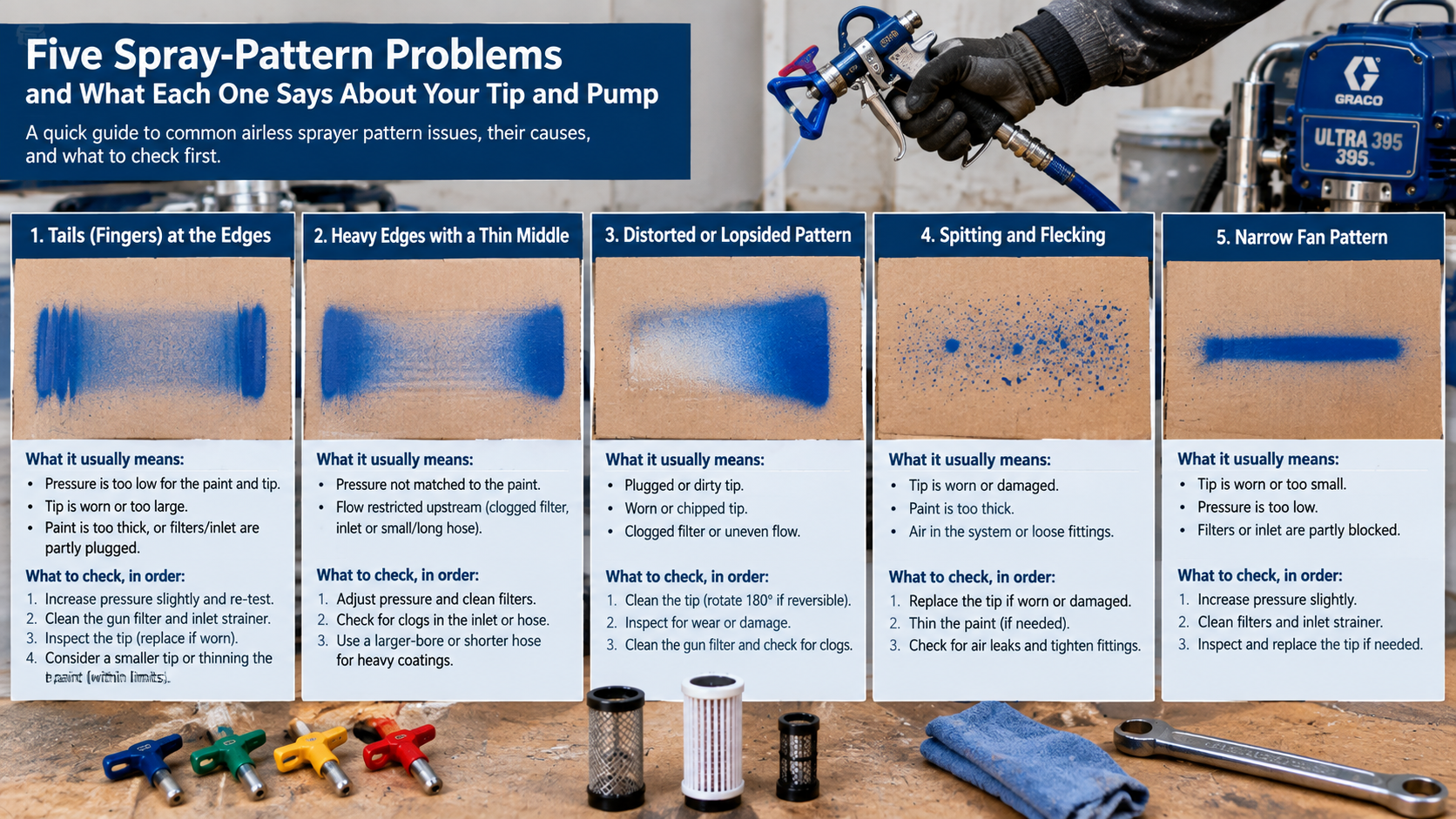
Problem 1: Tails (fingers) at the edges
Tails are streaks of heavier paint at the edges of the fan, with a thin band between them. They are the most common pattern complaint, and the most common cause is the simplest one: the paint is not being atomized properly.
What it usually means
- The pressure is too low for the paint and the tip. Titan and Wagner list low pressure as the main cause, and Graco’s quick reference points to a worn or oversized tip.
- The tip is worn or too large for the sprayer. A tip that has been used past its life, or one larger than the machine can drive, will tail at almost any setting.
- The paint is too thick, or the filters and inlet are partly plugged.
What to check, in order
- Raise the pressure a little and re-test. If the tails disappear, the setting was the problem.
- Clean the gun filter and the inlet strainer.
- Look at the tip. If the pattern is only good at full pressure, the tip is probably worn. Replace it rather than chasing it with more pressure.
- If you are spraying a heavy coating, consider a smaller tip or thinning within the coating maker’s limits.
If the tip is the cause, spray tips, tip filters and gun parts are normally identified by tip number, which makes it straightforward to match the replacement.
Problem 2: Heavy edges with a thin middle
A pattern that deposits most of its paint at the edges and very little in the center is often a pressure or supply issue rather than a tip defect.
- Pressure not matched to the paint. Graco’s guidance is to adjust the pressure and clean the filters. If adjusting pressure does not fix it, a smaller tip may.
- Flow restricted somewhere upstream. A clogged filter, a partly blocked inlet or a hose that is too long or too small can all shrink the fan. Graco’s materials note that on long runs, a 3/8-inch hose loses much less pressure than a 1/4-inch hose, and that a larger-bore or shorter hose helps heavy edges.
The takeaway: when the edges are heavy, look at what is between the pump and the tip before blaming the pump.
Problem 3: A distorted or lopsided pattern
If the fan is lopsided, has a hole in it or looks like a diamond, suspect the tip first. A partially plugged orifice, a nick in the tungsten carbide or a chipped tip disturbs the sheet of paint as it leaves the tip.
- Plugged or dirty tip: clean it. Graco’s homeowner FAQ notes that rotating a reversible tip 180 degrees can clear a plug. Follow the reverse-tip steps in your own manual, point the gun at a waste pail and never put a hand or finger over the tip.
- Worn or chipped tip: replace it. A damaged orifice does not recover.
- A heavy center on an otherwise clean tip: Titan’s guidance is to replace a worn or chipped tip.
A distorted pattern that stays distorted after the tip is replaced points to something else, usually the gun, a damaged tip seal or a badly placed tip guard. That is when to inspect the gun.
Problem 4: Spitting and globs
Spitting is a burst of paint in the spray, often followed by a short gap. Some spitting is inherent to airless spraying, and Graco notes that pulling the trigger quickly and off the surface helps. If it is constant, the causes are usually in this list:
- Air in the pump or hose. Check the connections on the suction side, re-prime and cycle the pump slowly. An air leak at a loose suction joint is a common source.
- A partly clogged tip or filter. Clean the tip and the gun filter.
- A low paint supply. If the suction tube is not fully submerged, the pump pulls air.
- A dirty gun or a needle out of adjustment on guns that have one, and on some guns a chipped seat.
- A worn tip or needle, which Graco lists among the causes.
If air keeps coming back after every suction connection is tight, the pump itself becomes a suspect: Graco lists worn packings and an intake valve that does not seat among the causes of a pump that is hard to prime. Look at the pump only after the cheap checks have all been done.
Problem 5: A pattern that shrinks or pulses during the job
A fan that starts wide and gets narrower, or one that pulses in and out, is telling you that something is changing as you work. Common causes:
- Filters loading up. Graco’s tables list a restricted filter as a cause of a shrinking pattern. Clean the gun filter and check the manifold filter.
- A worn tip. As the orifice wears, the fan narrows and the sprayer uses more paint.
- Surging. Graco’s quick reference lists a hose that is too long or the wrong diameter, a plugged tip, a clogged outlet filter and worn pump parts as the causes of excessive surges at the gun. Titan adds that a leak in the suction tube can make the pattern expand and contract.
If all of those check out and the pump still pulses, the intake or piston valves, or the packings, are the next suspects. Replacing those parts is a bigger job, so confirm the diagnosis with the cheaper checks first.
A quick reference table
| What you see | Most likely causes | Check first |
|---|---|---|
| Tails (fingers) at the edges | Low pressure; worn or oversized tip; thick paint; plugged filters | Raise pressure slightly, then replace the tip if it is worn |
| Heavy edges, thin center | Pressure mismatch; restricted flow; hose too long or too small | Adjust pressure, clean filters, review hose length and diameter |
| Distorted or lopsided fan | Partly plugged, chipped or worn tip | Clean the tip, then replace it |
| Spitting or globs | Air in the system; partly clogged tip; low supply; dirty gun | Check suction connections and paint level, clean the tip |
| Shrinking or pulsing fan | Loaded filters; worn tip; hose; worn pump valves or packings | Clean filters, check the tip, then the hose |
Match the filter to the tip
Filters and tips work as a pair. A fine tip with a coarse filter lets debris reach the orifice and clog it. A coarse tip with a very fine filter chokes the flow. As a guide, Titan’s manuals suggest roughly a 100-mesh filter with the smallest tips (0.011 to 0.013 inch), 60 mesh with mid-range tips (0.015 to 0.019 inch) and 30 mesh with the largest (0.021 to 0.026 inch). If a tip keeps clogging, Graco suggests a 100-mesh gun filter or straining the paint through nylon. Mesh sizes vary by gun and manifold, so check what your gun accepts. Replacement gun, manifold and inlet filters come in several mesh sizes for this reason.
When the pattern problem is really a pump problem
Most pattern complaints stop at the tip or the filters. The pump becomes the suspect when:
- You have a new tip, clean filters and a good hose, and the pressure still will not hold.
- Paint is leaking at the packing nut or running down the pump body.
- The pump keeps cycling when the gun is closed, which points to internal leakage.
- The sprayer will not prime or loses prime repeatedly.
In those cases, a worn packing set or a valve that is not seating is more likely than a tip fault. If you want a longer list of the parts involved and how they relate to each symptom, this guide to common spray pattern problems and the parts that solve them sets out the options by symptom, so you can match the fault to the part before you order anything.
Frequently asked questions
Why does my airless sprayer leave tails?
Tails usually mean the paint is not being fully atomized: pressure too low for the paint and tip, a worn or oversized tip, thick paint or plugged filters. Raise the pressure a little first, clean the filters and replace the tip if it is worn.
How often should I replace a spray tip?
When the fan is noticeably narrower than a new tip’s, or the pattern develops tails or a diamond shape that you cannot fix with pressure. Tip life depends on the coating, the pressure and whether the paint is strained, so watch the pattern rather than counting gallons.
Is spitting a sign that the pump is bad?
Not usually. Air in the line, a clogged tip or filter, and a low paint supply are far more common. Check those and the suction-side connections before you open the pump.
Can a bigger tip fix a thin pattern?
Only if the original tip was too small for the paint. A tip that is too large for the sprayer makes pulsing and tails worse, because the pump cannot supply enough paint. Graco gives maximum tip sizes for its machines, so check your manual.
The short version
Read the pattern, change one thing at a time and keep the order: pressure, tip, filters, hose, then the pump. If you build the habit of testing on cardboard and keeping a couple of spare tips and filters in the truck, most pattern problems are solved in a few minutes rather than turning into a lost afternoon.
About the author
The eRepairCenter parts team helps painters, contractors and maintenance crews identify and replace worn parts on airless paint sprayers. eRepairCenter is a Houston, Texas supplier of aftermarket, used and surplus replacement parts and an authorized Bedford Precision distributor, shipping across the United States.
