
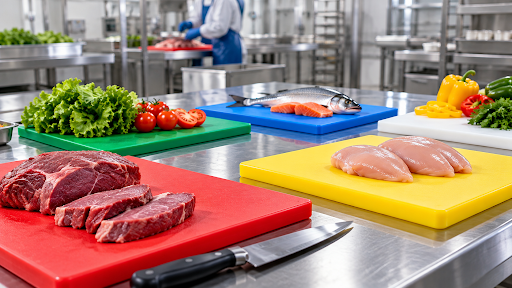
Food safety auditors judge a cutting surface on four things:
- Its physical condition
- Its colour-coding
- Its cleaning and storage
- The paperwork behind it
UK food safety law strictly mandates cross-contamination prevention using durable, easily sanitised equipment. Because of these requirements, high-density colour-coded boards are the industry standard for compliance.
The audit can come from a Local Authority Environmental Health Officer or a third-party scheme such as BRCGS or ISO 22000. The focus stays the same, no matter who carries it out. For a food factory, the right industrial chopping board is central to passing that test.
Here is what each auditor checks, and how to be ready for it.
5 Things Auditors Check in Industrial Chopping Boards
1. Physical Condition and Material Integrity
The state of the plastic cutting board is usually the first thing an auditor flags on a walkthrough. A worn surface raises an immediate concern, and auditors look for three faults.
Deep knife scoring is the main one. As a board wears, knife grooves create microscopic valleys where bacteria and cleaning chemicals can hide from sanitising. Auditors run a hand or a swab across the surface to check for deep pitting.
Material compliance is the second fault area. Boards must be non-porous and made from a food-contact-approved plastic that can be sanitised at scale. Wooden boards are heavily discouraged in industrial processing because they are porous and cannot be effectively disinfected. A plastic cutting board gives the smooth, sealed surface an auditor expects to find.
Warping is the third. A board has to sit completely flat on the prep table. Why? Because a warped one is a knife-slip hazard and can trap organic matter underneath. A large plastic chopping board that has been cupped in the wash will be marked down on sight. Hence, flatness matters as much as cleanliness.
Across all three faults, well-made industrial chopping boards that resist scoring and hold their shape give an auditor little to flag.
2. Cross-Contamination and Colour-Coding
Auditors cross-reference how your boards are used against your HACCP plan. The colour system has to be applied consistently across every line and every department.
Here is the UK standard chart an auditor checks against:
| Colour | Designated use |
| Red | Raw meat and poultry |
| Blue | Raw fish and shellfish |
| Yellow | Cooked meats |
| Green | Washed salad, fruit, and herbs |
| Brown | Unwashed root vegetables |
| White | Bakery and dairy |
| Purple | Allergen-free preparation |
It is a major non-conformance if a staff member is found cutting cooked chicken on a red board. The same applies if the colour system changes between one line and the next. Using reliable commercial chopping boards in the correct colours across all lines is what proves compliance.
3. Cleaning, Sanitisation, and Storage
An auditor also assesses how boards are treated when they are not in use. Storage is a common failure point. But it is an easy one to get right.
Boards must be stored upright in dedicated stainless steel racks with gaps between them for air drying. Stacking wet boards flat creates a dark, moist environment where bacteria breed. Boards must also be kept off the floor at all times.
Additionally. auditors frequently run unannounced ATP swab tests directly on the boards. These tests confirm if the wash process actually removes bacterial biofilms.
4. Due Diligence and the Audit Trail
UK law requires a business to prove a “due diligence” defence. This means you must show an established system that actively monitors equipment, and the paperwork is what carries that proof.
Technical managers need to produce two things on request:
- Documented cleaning schedules for all cutting surfaces
- Replacement and resurfacing logs showing boards are maintained on a set frequency
Many industrial sites use a managed rotation service that collects worn boards, shaves them smooth, or replaces them. A contract or log proving this frequency shows the auditor you are proactive. A board kept to a maintenance record is a far stronger position than one replaced only after a fault appears.
5. Why Board Choice Shapes Every Pillar
The four pillars connect back to one decision: the board you buy in the first place.
A cheap, low-quality board:
- Scores quickly
- Warps in the wash
- Forces constant replacement
A high-quality board changes that picture. A durable surface resists scoring. So it stays smooth between audits. A thick board holds flat under heavy chopping, which removes the warping risk. A board that lasts also makes the maintenance log easier to keep.
Specifying the right board early is therefore a compliance decision. It sets the baseline for how easily your site passes every future walkthrough.
How to Pass the Board Inspection
Passing an audit comes down to preparation across all five points above.
- Keep the surfaces sound
- Apply the colour system without exception
- Store and clean the boards properly
- Hold the paperwork to prove it
Start by conducting a quick audit this week. Inspect your line and remove any warped or scored items right away. When replacing those damaged items, quality matters. Investing in a heavy duty chopping board designed for industrial use reduces replacement frequency. This helps keep your kitchen compliant and lowers maintenance effort over time.
The best chopping board for an audited site is one that stays flat, resists scoring, and comes with a maintenance trail behind it. Equipping your prep stations with specified food-grade chopping boards ensures one less compliance worry on inspection day.
FAQs
What material must industrial chopping boards be made from?
The best chopping board must be non-porous and food-contact approved, so the surface can be sanitised thoroughly and repeatedly. Wooden boards are discouraged in processing because they are porous and cannot be disinfected at scale.
How often should a food factory replace or resurface its boards?
There is no fixed legal interval, but boards must be replaced or resurfaced before scoring gets deep enough to harbour bacteria. A documented schedule is what proves due diligence to an auditor.
What is an ATP swab test and why do auditors use it?
An ATP swab measures biological residue left on a surface after cleaning. Auditors use it to confirm the wash process removes bacterial biofilms rather than just visible marks.
Does using colour-coded boards guarantee I pass an audit?
No, the colours must be applied consistently and the boards kept in good repair. An auditor checks real usage against your HACCP plan, not only the presence of coloured boards.
