
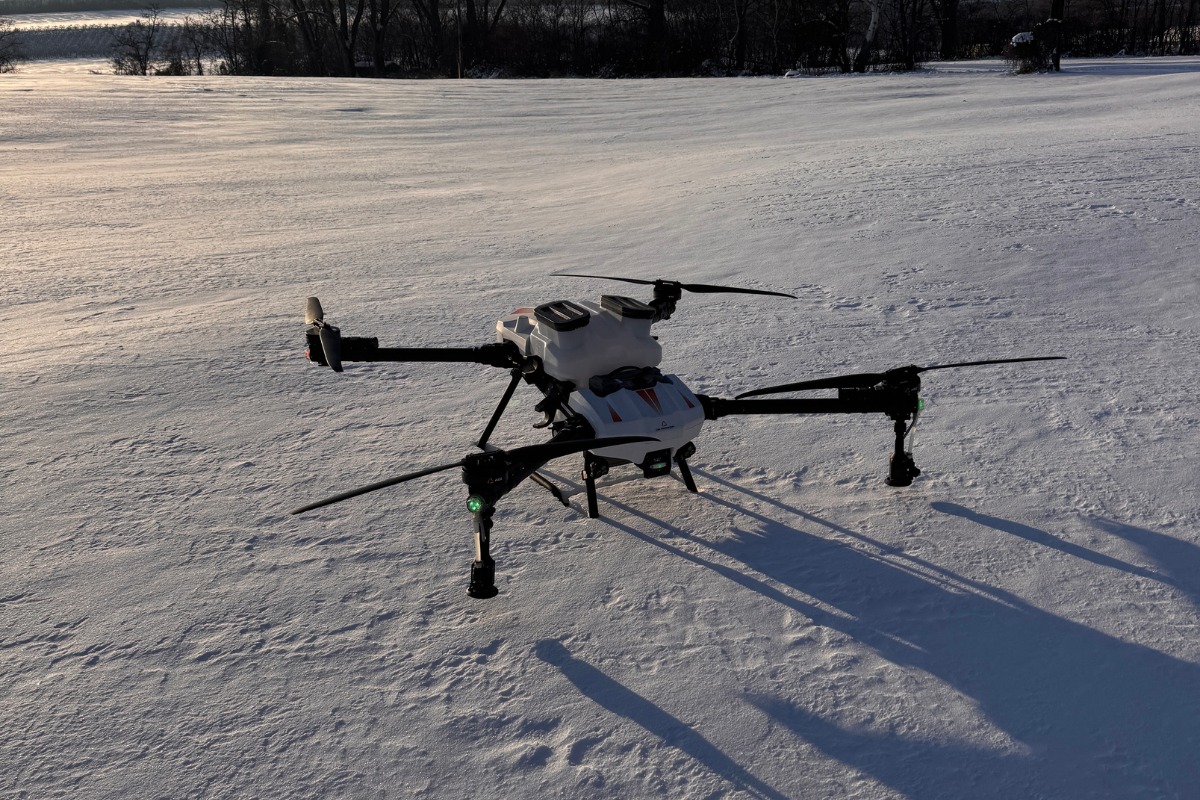
Many farmers associate aerial application with the spraying season, yet the working year does not end with the last harvest. Autumn brings cover-crop seeding, post-harvest orchard treatments, and field work on soil that is often too wet for tractors. ABZ Innovation designed its L-series so that the same aircraft can switch between spraying and spreading tasks. With a spreading system, agro drones remain productive in the months when wheeled machinery stays in the barn.
Cover crops and seeding from the air
Cover crops protect the soil over winter, but the sowing window after harvest is short and often coincides with rain. A spreading system mounted on the aircraft can distribute seed evenly across a field without waiting for the ground to dry. The L50, for example, is compatible with a 70-liter spreading unit for this type of work. ABZ developed the spreading option so that the aircraft stays in use beyond the spraying season.
Orchard treatments after the picking season
Fruit growers often apply protective treatments after leaf fall, when the canopy is open and coverage is easier to achieve. Aerial application reaches rows that are difficult to enter with a sprayer once the soil becomes soft. The adjustable CDA rotating-disc system of the ABZ L-series allows the droplet size to be set according to the product and the conditions. Timely autumn applications can reduce disease pressure in the following spring.
Which tasks fit the colder months?
Operators can plan the off-season around several typical jobs:
- seeding of cover crops and green manure
- spreading granular fertilizer on wet fields
- post-harvest protective treatments in orchards and vineyards
- slug pellet application on emerging crops
- mapping flights to plan next year’s zones
Each of these jobs benefits from the fact that the aircraft never touches the ground inside the field.
No trampling and no waiting for dry soil
Autumn soil is vulnerable, and every tractor pass compacts it or leaves ruts that remain until spring. Agro drones apply seed and fertilizer without wheel traffic, and they can operate immediately after rain. This keeps the treatment on schedule and protects soil structure at a time of year when recovery is slow. For many farms, this flexibility is the main reason to keep the aircraft working in autumn.
A longer working year for the same investment
An aircraft that works in spring, summer, and autumn pays for itself faster than one that waits for the next spraying season. By combining spraying and spreading, agro drones cover a wider range of field tasks with one platform. ABZ customers in more than 40 countries use this flexibility to protect soil, keep schedules, and reduce machinery hours. ABZ Innovation continues to develop accessories that extend the useful season of its L-series even further.
