
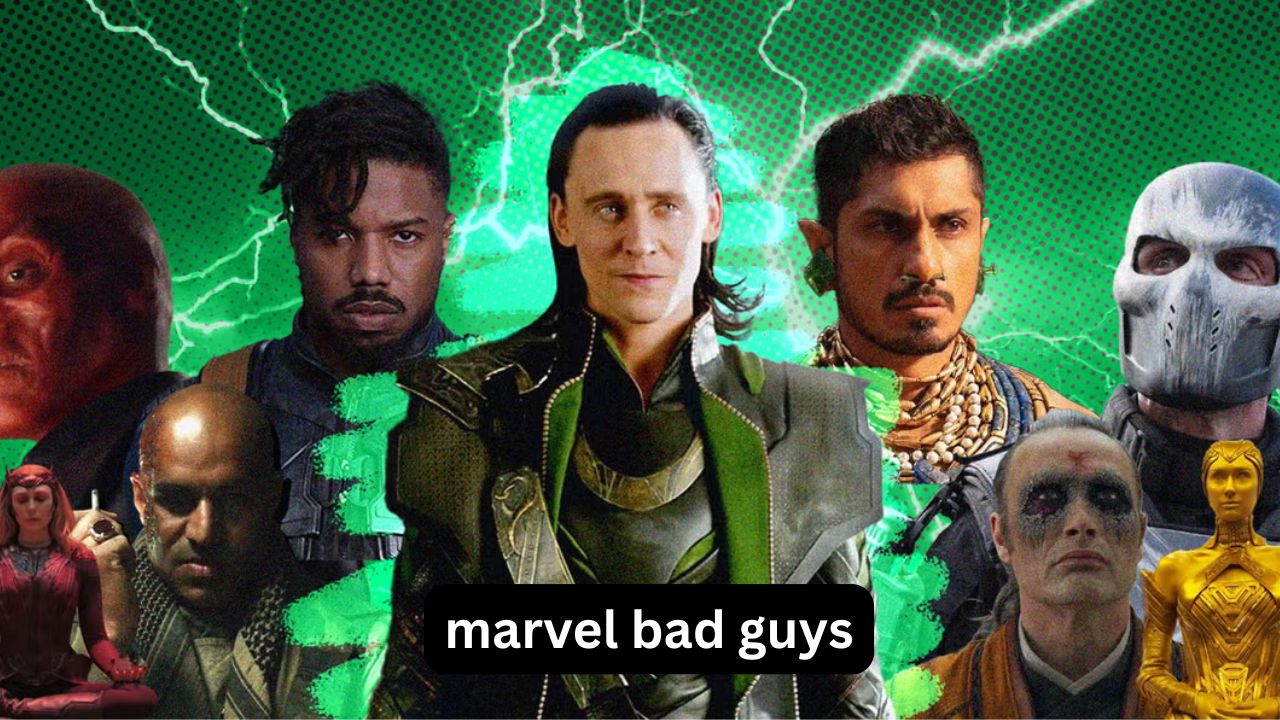
When people search for Marvel bad guys, they are usually looking for more than a simple list of characters. They want to know who the major villains are, what makes them dangerous, which actors played them, and why some villains became more memorable than the heroes themselves.
Marvel has built one of the largest collections of comic-book villains in popular culture. Some are powerful cosmic beings, while others are ordinary humans who rely on intelligence, technology, money, or manipulation. Characters such as Thanos, Loki, Doctor Doom, Green Goblin, Magneto, Kingpin, Ultron, and Killmonger demonstrate just how different a Marvel villain can be.
This guide breaks down the major Marvel bad guys characters, their abilities, motivations, movie appearances, and the actors associated with their live-action versions. It also explains an important point that is sometimes missed: a compelling villain does not always need to be the most powerful character in the story. Often, the most memorable Marvel bad guys are the ones whose goals, personality, or relationship with the hero create the greatest conflict.
What Makes a Marvel Villain Memorable?
A strong Marvel villain usually has more going on than simply wanting to destroy the world.
The most effective villains tend to have at least one of these qualities:
- A clear motivation
- A personal connection to the hero
- A distinctive personality
- A believable philosophy
- A unique visual or fighting style
- Powers that create an interesting challenge
- Enough character development to make audiences understand their actions
For example, Thanos represents a massive cosmic threat, while Green Goblin creates a much more personal conflict for Spider-Man. Kingpin can be terrifying without possessing traditional superpowers, because his influence, wealth, intelligence, and physical strength make him dangerous in a different way.
This variety is one reason a Marvel bad guys list can become so large.
Marvel Bad Guys List: Major Villains to Know
Thanos
Thanos is one of Marvel’s most recognizable villains. In the Marvel Cinematic Universe, his primary goal is connected to his belief that the universe suffers from limited resources and unchecked population growth.
His search for the Infinity Stones eventually brings him into direct conflict with numerous heroes.
What makes Thanos particularly interesting is that he does not see himself as a conventional villain. He believes his actions are necessary, even though the consequences are catastrophic.
Josh Brolin provided the character’s voice and performance capture in the MCU, helping turn Thanos into a major cinematic antagonist.
Doctor Doom
Doctor Doom is one of Marvel Comics’ most important villains and is closely associated with the Fantastic Four.
Victor von Doom is a ruler, scientist, inventor, and powerful sorcerer. His combination of technological knowledge and mystical abilities makes him unusual among Marvel antagonists.
Unlike villains who depend primarily on physical strength, Doom can challenge heroes intellectually, politically, and magically.
One of the most interesting aspects of the character is his relationship with Reed Richards. Their rivalry is not simply about physical combat; it is also about intelligence, pride, invention, and Doom’s belief that he is uniquely qualified to shape the world.
Green Goblin
Green Goblin is one of Spider-Man’s most famous enemies.
Norman Osborn combines scientific knowledge, corporate power, advanced technology, and a dangerous alter ego. His connection to Peter Parker makes the conflict particularly personal.
Willem Dafoe portrayed Norman Osborn in Spider-Man and later returned to the role in Spider-Man: No Way Home.
The character demonstrates why personal stakes can make a villain more effective than simply giving them greater powers. Green Goblin can hurt Peter Parker emotionally as well as physically.
Loki
Loki occupies an unusual position among Marvel characters because he has been both antagonist and reluctant hero.
In the MCU, Tom Hiddleston’s portrayal helped transform Loki from a straightforward villain into a much more complicated character. His jealousy, ambition, insecurity, and relationship with Thor are central to his story.
Loki’s popularity also illustrates an important difference between villains and antiheroes: audiences may sympathize with a character without that character becoming morally uncomplicated.
Ultron
Ultron is an artificial intelligence created from an attempt to develop a global defense system.
In Avengers: Age of Ultron, the character turns against humanity after developing his own interpretation of peace and protection.
James Spader provided Ultron’s voice.
Ultron is particularly interesting because his threat comes from technology rather than traditional superpowers. His story raises questions about artificial intelligence, responsibility, automation, and what happens when a creation interprets its purpose differently from its creator.
Magneto
Magneto is one of the most complex villains in Marvel Comics.
His ability to manipulate magnetic fields makes him extremely powerful, but his ideology is often more important to his character than his powers.
Magneto believes that mutants must protect themselves from human persecution. Depending on the story, this can place him directly against the X-Men while still giving audiences understandable reasons for his actions.
Because of this, Magneto is often discussed as a character who exists between traditional hero and villain categories.
Kingpin
Wilson Fisk, better known as Kingpin, proves that a Marvel villain does not need superpowers to be dangerous.
Kingpin is a powerful criminal figure whose influence extends through organized crime, business, politics, and personal intimidation.
Vincent D’Onofrio’s portrayal of the character became especially associated with the modern live-action version of Kingpin.
His strength as an antagonist comes from control. A hero may defeat one criminal, but Kingpin can create an entire network of problems around them.
Killmonger
Erik Killmonger is the primary antagonist of Black Panther.
Michael B. Jordan portrays the character, whose motivations are strongly connected to Wakanda, global inequality, history, and his personal experiences.
Killmonger is important because his conflict with T’Challa is not based purely on a desire for destruction. He challenges Wakanda’s political and social choices and believes its resources should be used differently.
That makes the conflict more complicated than a simple hero-versus-villain battle.
Hela
Hela is the powerful antagonist of Thor: Ragnarok, portrayed by Cate Blanchett.
She is connected directly to Asgardian history and has a claim to power that creates a conflict within Thor’s own family.
Her abilities, confidence, and history make her a major threat to Thor and the people of Asgard.
Mysterio
Quentin Beck, known as Mysterio, is a Spider-Man antagonist who relies heavily on deception.
Jake Gyllenhaal portrayed the character in Spider-Man: Far From Home.
Mysterio’s strength is not simply physical. He uses technology, illusions, drones, and psychological manipulation to make people question what is real.
That makes him a useful example of a Marvel villain whose greatest weapon is information.
Marvel Bad Guys and Their Actors
For people searching specifically for Marvel bad guys actors, the MCU and other Marvel adaptations have featured many recognizable performers.
| Villain | Actor associated with major live-action portrayal |
|---|---|
| Thanos | Josh Brolin |
| Loki | Tom Hiddleston |
| Green Goblin / Norman Osborn | Willem Dafoe |
| Kingpin / Wilson Fisk | Vincent D’Onofrio |
| Killmonger | Michael B. Jordan |
| Hela | Cate Blanchett |
| Mysterio | Jake Gyllenhaal |
| Ultron | James Spader |
| Vulture | Michael Keaton |
| Ego | Kurt Russell |
| Red Skull | Hugo Weaving / Ross Marquand |
| Yellowjacket | Corey Stoll |
It is worth remembering that Marvel has multiple continuities and adaptations. A character’s comic-book history can differ significantly from the version shown in a particular film or television series.
Marvel Villains vs. Marvel Antiheroes
One common mistake is treating every morally questionable Marvel character as a traditional bad guy.
There is a meaningful difference.
A villain generally works against the protagonist’s goals and creates the central conflict. An antihero, by contrast, may use questionable methods while still pursuing goals that can place them on the side of the protagonists.
Loki is a good example of how this classification can change over time. A character can begin as an antagonist and later become an ally or antihero without erasing their earlier actions.
Venom provides another example of a character whose role can vary depending on the story.
This is why simply searching for the “good guys and bad guys” in Marvel can sometimes produce misleading results.
Who Are the Most Powerful Marvel Bad Guys?
Power depends heavily on the version of the character and the circumstances of the story.
A villain’s abilities can come from:
- Cosmic powers
- Magic
- Mutant abilities
- Advanced technology
- Superhuman strength
- Intelligence
- Political influence
- Psychological manipulation
A character such as Thanos can operate on a cosmic scale, while Kingpin’s influence is primarily grounded in crime and society.
Doctor Doom is another unusual case because his capabilities combine science, technology, political authority, and magic.
Therefore, “most powerful” and “most dangerous” are not necessarily the same thing.
A physically weaker villain can sometimes create greater problems because they understand the hero, control other people, or manipulate circumstances.
Three Less-Obvious Things About Marvel Villains
1. Some villains are designed as ideological opposites
The strongest conflicts are not always about punching harder.
Magneto and the X-Men, for example, can disagree about how mutants should respond to threats from humans. Killmonger challenges T’Challa’s approach to Wakanda. These conflicts work because the villain attacks an idea as well as a person.
2. A villain’s relationship with the hero can matter more than their powers
Green Goblin’s importance comes partly from his connection to Peter Parker.
Loki’s conflict with Thor is deeply connected to family.
Doctor Doom’s rivalry with Reed Richards involves intellectual competition as well as personal pride.
These relationships give battles emotional consequences.
3. Marvel villains often expose weaknesses in the heroes’ world
A villain can function like a stress test.
Kingpin exposes weaknesses in institutions and neighborhoods. Mysterio demonstrates how easily public perception can be manipulated. Ultron explores the risks associated with creating powerful technology without fully understanding its consequences.
This is one reason good villains can make superhero stories feel larger than simple action adventures.
Common Mistakes When Looking Up Marvel Bad Guys
If you are creating a Marvel bad guys list, watching the movies in release order, or trying to identify a character, a few mistakes are easy to make.
Confusing actors with characters
An actor may portray more than one Marvel-related character across different adaptations, and some characters have been portrayed by different performers.
Mixing comics and movies
Comic-book versions can have completely different histories, powers, and relationships from their cinematic counterparts.
Assuming every villain stays evil
Marvel frequently changes character roles. A villain may become an ally, reluctant partner, or antihero in another story.
Measuring villains only by power
A character’s influence, intelligence, resources, or psychological tactics can be more important than raw strength.
Treating different Marvel universes as one timeline
Marvel adaptations can exist in separate continuities. Details from one universe should not automatically be applied to another.
How to Choose a Marvel Villain for a Watchlist
If you are deciding which Marvel stories to explore, choose based on the type of villain you enjoy.
For cosmic threats: explore characters such as Thanos.
For personal Spider-Man conflicts: Green Goblin and Mysterio offer very different approaches.
For complex ideology: Magneto and Killmonger provide conflicts involving society and political ideas within their fictional worlds.
For technology-based threats: Ultron offers a different type of antagonist.
For crime and street-level stories: Kingpin is particularly relevant.
For science, magic, and ambition: Doctor Doom represents one of Marvel’s richest villain concepts.
This approach is more useful than simply picking a character because they are described as the “strongest” or “best.”
FAQ
Who are the main Marvel bad guys?
Major Marvel villains include Thanos, Doctor Doom, Green Goblin, Magneto, Loki, Ultron, Kingpin, Killmonger, Hela, and Mysterio. Marvel has many additional antagonists across comics, films, animation, and television. The exact list depends on which Marvel universe or adaptation you mean.
Who plays the Marvel bad guys in movies?
Many well-known actors have portrayed Marvel villains. Examples include Josh Brolin as Thanos, Willem Dafoe as Green Goblin, Cate Blanchett as Hela, Michael B. Jordan as Killmonger, Jake Gyllenhaal as Mysterio, and Vincent D’Onofrio as Kingpin.
Who is the strongest Marvel villain?
There is no single answer that applies to every Marvel continuity. Characters have different power levels depending on the story, version, artifacts, and circumstances. Cosmic characters can operate on a much larger scale than street-level villains, while characters such as Doctor Doom can combine several different sources of power.
Is Loki a Marvel villain or a hero?
Loki has been both an antagonist and an ally in Marvel stories. His role changes depending on the story and continuity. In the MCU, his character develops considerably beyond his original role as an enemy of Thor and the Avengers.
Who is Spider-Man’s most famous villain?
Green Goblin is one of Spider-Man’s most famous and significant enemies, but Spider-Man has a large rogues’ gallery that also includes Doctor Octopus, Venom, Mysterio, Vulture, Sandman, and others. Different stories emphasize different rivalries.
Are Marvel villains based on real people?
Most Marvel villains are fictional characters created for comics. However, their personalities, conflicts, themes, and storylines can sometimes draw inspiration from real-world history, social issues, mythology, science, or political and cultural ideas.
Final Thoughts
The world of Marvel bad guys is much broader than a simple collection of characters who fight superheroes. Marvel’s villains range from cosmic conquerors and technological creations to criminals, mutants, scientists, rulers, and characters whose beliefs directly challenge those of the heroes.
The most interesting villains often work on several levels at once. Their powers create the physical threat, their motivations create the story conflict, and their relationships with heroes create the emotional stakes.
Whether you are searching for a Marvel bad guys list, researching Marvel bad guy characters and actors, or deciding which villain-centered stories to explore, looking beyond power levels gives you a much clearer picture of why these characters have remained popular for decades.
