

Henry Vaughan remains one of the most fascinating voices of seventeenth-century English literature. Known for his spiritual depth, mystical imagery, and connection to nature, he stands among the major metaphysical poets of his era. Readers searching for Henry Vaughan poems, famous works, The World, The Retreat, or even questions like who is Henry Vaughan often discover a poet whose work bridges religious devotion and imaginative philosophy. This detailed article explores his biography, literary achievements, pronunciation, adopted name, important books, and his relationship with poets such as Thomas Vaughan, George Herbert, Richard Crashaw, and Andrew Marvell.
Who Is Henry Vaughan?
Henry Vaughan was a Welsh metaphysical poet, translator, and physician born in 1621 or early 1622 in Breconshire, Wales. He lived during a time of political upheaval and religious conflict in Britain, which deeply influenced his writing. Vaughan began his career composing secular poetry, but after a spiritual awakening—largely inspired by George Herbert—his work turned strongly devotional.
His poetry is admired for its rich symbolism, visionary tone, and philosophical reflection on eternity. Unlike many poets who focused on worldly themes, Vaughan’s writing explores divine light, innocence, memory, and humanity’s relationship with God. Because of this mystical quality, he later earned the literary title “the Silurist,” reflecting his Welsh heritage.
Henry Vaughan Pronunciation and Adopted Name
Many readers are unsure about the correct pronunciation of his surname. Henry Vaughan is commonly pronounced “HEN-ree VAWN.” The silent “gh” and soft vowel sound make it distinct from its spelling.
Vaughan often used the adopted literary name “Silurist.” This title comes from the ancient Celtic tribe known as the Silures, who lived in southern Wales. By adopting this name, he emphasized his cultural identity and spiritual connection to his homeland. The name also symbolized his poetic persona as a visionary voice rooted in nature and history.
Henry Vaughan’s Life and Spiritual Transformation
Henry Vaughan studied law in London and may have attended Oxford, though details of his education remain uncertain. Early in life, he published a volume of secular poetry, but the English Civil War and personal hardships deeply affected him. Illness and political instability led him toward religious reflection.
The turning point in Vaughan’s life came when he discovered the poetry of George Herbert. Herbert’s devotional verse inspired Vaughan to abandon his earlier worldly themes and dedicate himself to spiritual poetry. After this transformation, his writing became more introspective, emphasizing eternity, divine presence, and the innocence of childhood.
In addition to poetry, Vaughan worked as a physician in Wales, combining scientific curiosity with mystical philosophy—an intellectual blend that also influenced his twin brother Thomas Vaughan.
Thomas Vaughan — Who Is He?
Thomas Vaughan was Henry Vaughan’s identical twin brother, but his interests took a different direction. Rather than focusing on poetry, Thomas became known as a philosopher, alchemist, and writer associated with Hermetic and mystical traditions. He often wrote under the pseudonym Eugenius Philalethes, producing works that explored spiritual science, alchemy, and esoteric knowledge.
Although Henry and Thomas pursued different literary paths, their works share a fascination with divine truth and the unseen world. Scholars frequently study the Vaughan brothers together because they reflect two sides of seventeenth-century mysticism—poetry and philosophical speculation.
Henry Vaughan’s Famous Works and Books
Henry Vaughan’s reputation largely rests on a small but powerful body of religious poetry. Among his most famous books are:
Silex Scintillans
This devotional collection, first published in 1650 and expanded in 1655, is considered his greatest achievement. The title translates roughly to “The Sparkling Flint,” symbolizing spiritual illumination. Many of Vaughan’s best-known poems appear in this volume.
Poems, with the Tenth Satire of Juvenal Englished (1646)
This early collection shows Vaughan’s initial interest in secular and classical themes before his spiritual transformation.
Mount of Olives; or, Solitary Devotions (1652)
A prose work reflecting his deep religious meditation and personal devotion.
These books helped define Vaughan’s reputation as one of the leading metaphysical poets, alongside figures like George Herbert and Andrew Marvell.
Henry Vaughan Poems and Literary Style
Vaughan’s poetry is characterized by vivid imagery, philosophical depth, and a sense of longing for spiritual purity. Some of his most famous poems include:
- “The World”
- “The Retreat”
- “They Are All Gone into the World of Light”
- “Peace”
- “Friends Departed”
His poetic themes often revolve around:
- The contrast between earthly life and eternal existence
- Childhood innocence as a symbol of spiritual purity
- Nature as a reflection of divine beauty
- The human soul’s journey toward God
Unlike the complex intellectual wit of some metaphysical poets, Vaughan’s style feels more mystical and contemplative. His imagery frequently draws on light, stars, and landscapes to convey spiritual ideas.
Henry Vaughan’s “The World” — Vision of Eternity
One of Vaughan’s most celebrated poems is “The World.” This piece opens with an image of eternity represented as a vast circle of light—a powerful metaphor for divine perfection. Throughout the poem, Vaughan contrasts eternal truth with worldly distractions such as wealth, ambition, and pleasure.
The poem reflects the metaphysical tradition through its use of symbolic imagery and philosophical reflection. Vaughan invites readers to look beyond material concerns and recognize the fleeting nature of earthly life. Many literary critics consider “The World” a masterpiece because it captures both spiritual awe and moral warning within a relatively short composition.
Henry Vaughan’s “The Retreat” — Childhood and Spiritual Innocence
Another major poem, “The Retreat,” expresses Vaughan’s longing to return to the innocence of childhood. In this poem, he imagines youth as a time when the soul remained closer to heaven, untouched by worldly corruption.
The poem resonates with readers because it explores universal feelings of nostalgia and spiritual yearning. Vaughan suggests that adulthood often distances people from their divine origin, yet memory can guide them back toward inner purity. This theme later influenced Romantic poets, who also celebrated childhood as a source of spiritual insight.
Relationship with Other Metaphysical Poets
George Herbert
George Herbert’s influence on Henry Vaughan cannot be overstated. Herbert’s devotional poetry provided a model for combining religious faith with artistic expression. After reading Herbert’s work, Vaughan shifted toward a more spiritual style, mirroring Herbert’s emphasis on humility and personal devotion.
Richard Crashaw
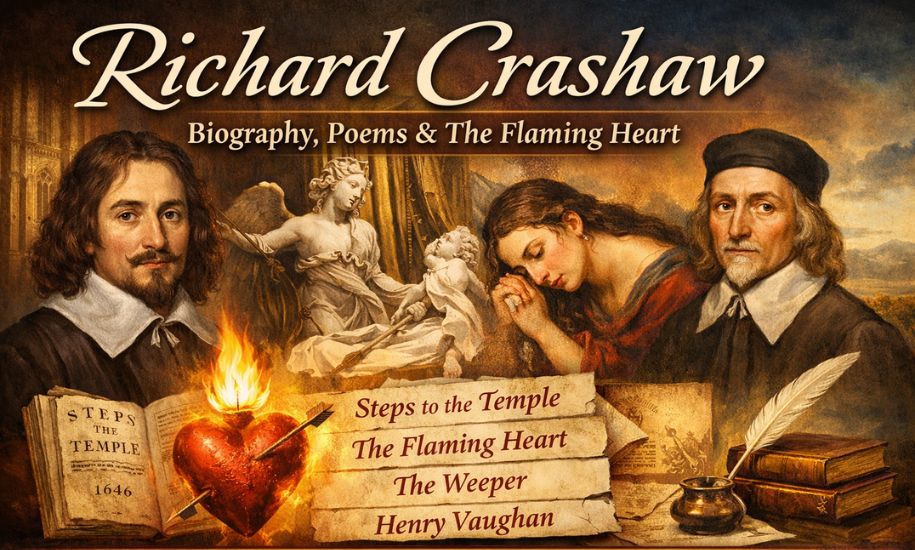
Richard Crashaw, another metaphysical poet, shared Vaughan’s intense religious passion. Crashaw’s poetry often features elaborate imagery and emotional intensity inspired by Catholic spirituality. Although their styles differ, both poets explore divine love and mystical experience.
Andrew Marvell
Andrew Marvell represents a slightly different branch of metaphysical poetry. While Vaughan focused on spiritual themes, Marvell blended metaphysical wit with political satire and philosophical reflection. Studying these poets together reveals the diversity within the metaphysical movement during the seventeenth century.
Themes and Legacy of Henry Vaughan
Henry Vaughan’s poetry stands out because of its deep connection to nature and mysticism. He often portrays the natural world as a mirror of divine reality, suggesting that spiritual truth can be glimpsed through everyday experiences.
Key themes in his work include:
- Eternal light and divine presence
- The loss of innocence
- Memory as a spiritual pathway
- The harmony between nature and faith
Although his poetry was not widely celebrated during his lifetime, Vaughan’s reputation grew in later centuries. Modern scholars recognize him as an important bridge between metaphysical poetry and the Romantic tradition. Writers such as William Wordsworth admired the way Vaughan linked childhood and nature with spiritual insight.
Henry Vaughan Died — Final Years
Henry Vaughan spent his later years practicing medicine in Wales and continuing his spiritual reflections. He died on 23 April 1695 and was buried in Llansantffraed churchyard. Despite a quiet life far from London’s literary circles, his poetry endured and gained renewed appreciation in the twentieth century.
Today, Vaughan is remembered as a poet who transformed personal faith into timeless art. His writings continue to inspire readers seeking deeper meaning in both poetry and spirituality.
Why Henry Vaughan Still Matters Today
In modern literary studies, Henry Vaughan is valued for his ability to combine intellectual depth with emotional sincerity. His poems invite readers to reflect on life’s larger questions—eternity, faith, innocence, and the human soul’s journey.
For readers discovering metaphysical poetry, Vaughan offers a gentle yet profound entry point. His language is rich but accessible, and his themes remain relevant in a world still searching for spiritual meaning. Writers and bloggers who explore classical English literature often highlight Vaughan because his work connects historical tradition with universal human experience.
If you are exploring English poetry through platforms like Wisto Blogs, studying Henry Vaughan can provide insight into how literature reflects both personal belief and cultural history. His legacy shows that even poets writing centuries ago can speak directly to modern readers.
Conclusion
Henry Vaughan stands among the most important metaphysical poets of the seventeenth century, known for mystical imagery, spiritual devotion, and timeless themes. Alongside figures like Thomas Vaughan, George Herbert, Richard Crashaw, and Andrew Marvell, he contributed to a rich poetic tradition that continues to influence readers and scholars today. From famous poems like The World and The Retreat to devotional books such as Silex Scintillans, Vaughan’s work reveals a deep longing for divine truth and eternal light. Readers visiting Wisto Blogs can explore how his poetry bridges history, faith, and artistic imagination, making him a lasting figure in English literary heritage.
